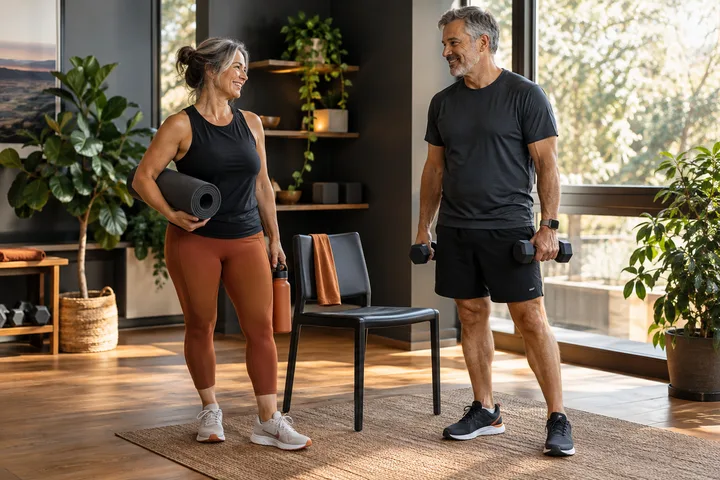
Two accessible full-body sessions prioritize strength practice and everyday function during weight loss. Suitable modifications help you find a manageable starting point, whether or not you use a GLP-1.
6 weeks · 2 or 3 days / week · 25–40 minutes · Home or gym
Loading your saved program…
Your progress stays in this browser on this device. It is not synced or sent to Physiforge. Clearing browser data, private browsing or changing devices may remove it. Export a copy regularly; keep exported notes private.
These are example weekdays. Shift the schedule to your life while keeping recovery between sessions.
Use two nonconsecutive days. A third session is optional only when energy and recovery are good; alternate A/B/A then B/A/B. Use a higher chair, wall push-up, lighter band or shorter range as needed. Missed sessions move forward with a rest day between them; there is no catch-up workout.
Warm up to the work.
Warm up with 5–8 minutes of easy movement you tolerate. Practice the first movements without load, then take 2–4 gradually heavier warm-up sets for the first compound lift. Warm-up sets do not count toward work sets. Take longer if you need it; begin work sets only when movement feels comfortable.
Make every rep useful.
Use a controlled lowering phase and a smooth lift through a comfortable range. Reps in reserve means how many more repetitions you could do with the same sound technique. It is an estimate, not a test: stop earlier when unsure. Listed sets are work sets. For unilateral exercises, complete both sides; each listed set includes both sides. Rest after both sides, or between sides if needed. Choose one substitute for a movement, not an additional exercise. Similar patterns do not have identical loading: start the substitute light.
THE WORKOUTS
Know the work before you start.
Everyday strength A
Everyday strength A — work sets; apply the weekly progression below
Weeks 1–2: use one set while learning, or two if already comfortable. Weeks 3–5: work toward the listed two sets before adding weight. When both sets reach the top of the range with 3–4 reps in reserve on two sessions, add a small amount of resistance. Week 6: keep comfortable loads, use one set if tired, and review strength, energy and consistency rather than scale change alone.
RECOVERY IS PART OF IT
Know when to ease back.
During low energy or reduced food intake, maintain a comfortable load and reduce sets rather than chasing more work. Persistent dizziness, unusual weakness, poor intake or medication-related symptoms warrant advice from your clinician. Stop exercising if symptomatic. This plan is not a treatment or a guarantee against muscle loss.
Before you lift
For adults 18+. These are general exercise plans, not individual medical or rehabilitation advice. If you have an injury, chronic condition, are pregnant/postpartum, or are unsure what activity is suitable, ask a qualified professional first. Stop for sharp pain, dizziness, unusual breathlessness or chest discomfort; seek urgent care for severe or persistent symptoms. Use stable equipment, inspect bands and anchors, and learn unfamiliar lifts with qualified coaching. Breathe through repetitions and avoid prolonged breath-holding.
Support the work outside the gym.
Food, sleep and recovery support the routine. Supplements are optional; a workout does not establish a need for a product.