Legs & glutes · Hinge
Dumbbell Romanian deadlift
Check the setup, practice a controlled repetition, then use your program’s sets, reps and rest.
Return to My Training →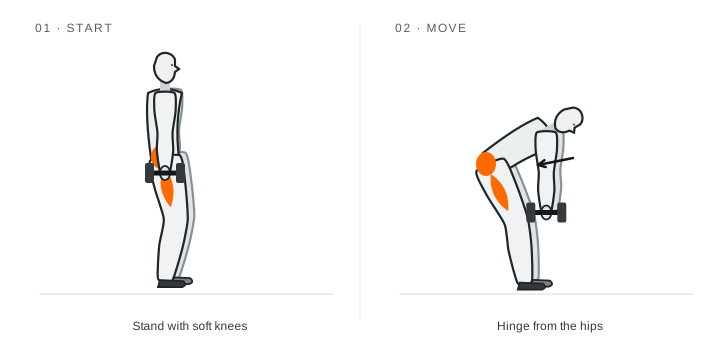
- Equipment
- Dumbbells
- Muscles worked
- Hamstrings, glutes, back stabilizers
- Movement
- Hinge
How to perform
- Stand tall with soft knees and weights near your thighs.
- Brace, move hips back and keep weights close to your legs.
- Stop when you feel hamstring tension without rounding your back.
- Drive hips forward to stand without leaning backward.
Three cues to remember
- Send hips back.
- Keep weights close to legs.
- Stop before your back rounds.
Common mistakes
- Reaching toward the floor.
- Rounding the back.
- Turning the hinge into a deep squat.
Slow the movement and reduce load or range if your position changes. Stop for pain rather than forcing the repetition.
Make it easier
Unloaded hip hinge to a wall or glute bridge.
Progress when ready
Add repetitions, then small load increases; a barbell is an option with coaching.
Practice with a light load. Diagrams show general positions, not an assessment of your form. Use the written setup and equipment instructions; get qualified coaching for unfamiliar lifts.
Find it in your program
Exercise guides explain the movement. Your training program sets the workload; an alternative replaces a movement rather than adding another one.
Instructional references
Original Physiforge instructions and diagrams use established movement principles. General references are not endorsements or individualized coaching.
NASM: Romanian deadlift reference ↗