Core · Trunk stability
Dead bug
Check the setup, practice a controlled repetition, then use your program’s sets, reps and rest.
Return to My Training →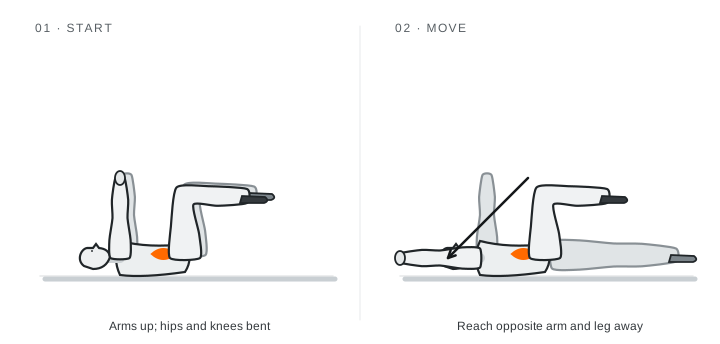
- Equipment
- Mat
- Muscles worked
- Trunk stabilizers
- Movement
- Trunk stability
How to perform
- Lie on your back, hips and knees bent.
- Gently brace and exhale as you reach one heel away and the opposite arm overhead.
- Keep a comfortable, steady low-back position.
- Return and alternate sides.
Three cues to remember
- Exhale as you reach.
- Keep your trunk steady.
- Shorten the reach before your back arches.
Common mistakes
- Arching as limbs reach.
- Holding the breath.
- Moving farther than you control.
Slow the movement and reduce load or range if your position changes. Stop for pain rather than forcing the repetition.
Make it easier
Slide one heel along the floor with arms still.
Progress when ready
Lengthen the reach gradually while keeping trunk position.
Practice with a light load. Diagrams show general positions, not an assessment of your form. Use the written setup and equipment instructions; get qualified coaching for unfamiliar lifts.
Find it in your program
Exercise guides explain the movement. Your training program sets the workload; an alternative replaces a movement rather than adding another one.
Instructional references
Original Physiforge instructions and diagrams use established movement principles. General references are not endorsements or individualized coaching.
NASM: dead bug ↗