Legs & glutes · Squat
Chair squat
Check the setup, practice a controlled repetition, then use your program’s sets, reps and rest.
Return to My Training →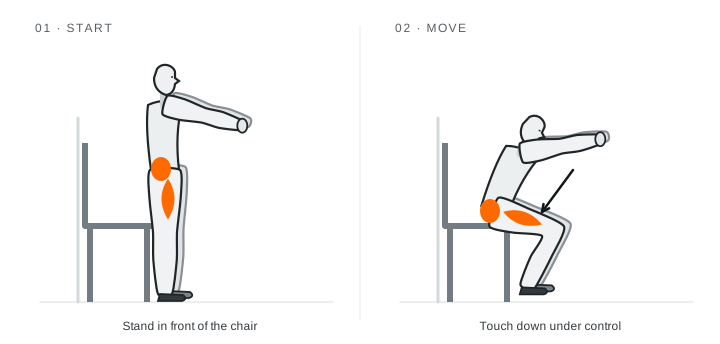
- Equipment
- Stable chair against a wall
- Muscles worked
- Quadriceps, glutes
- Movement
- Squat
How to perform
- Stand just in front of the chair, feet comfortably apart.
- Send hips back and bend knees toward your toes.
- Touch down under control, then push through your whole foot to stand.
- Use your hands for support if needed.
Three cues to remember
- Touch the seat gently.
- Keep the whole foot planted.
- Stand tall without rocking.
Common mistakes
- Dropping onto the seat.
- Knees collapsing inward.
- Using an unstable chair.
Slow the movement and reduce load or range if your position changes. Stop for pain rather than forcing the repetition.
Make it easier
Use a higher stable seat and hand support.
Progress when ready
Reduce hand assistance, then progress to a goblet squat.
Practice with a light load. Diagrams show general positions, not an assessment of your form. Use the written setup and equipment instructions; get qualified coaching for unfamiliar lifts.
Find it in your program
Exercise guides explain the movement. Your training program sets the workload; an alternative replaces a movement rather than adding another one.
Instructional references
Original Physiforge instructions and diagrams use established movement principles. General references are not endorsements or individualized coaching.
ACE: squat movement reference ↗